


Majuli Island is located in the Brahmaputra River between Assam, in northeast India. This island is a part of the region’s geographical and cultural diversity. It has a dense array of unique and rare flora and fauna. The island is a mixture of tranquillity and adventure. There are a variety of activities, which include kayaking and mist-blanketed wetlands in the Brahmaputra. The island hosts many schools, called “satras,” which feature unique Assamese and Vaishnava chanting. Ecotourism in Majuli will allow you enjoy an organic Assamese meal in the calm of a starlit sky, and the beauty of Assam, far away from the chaos of a major Indian city. The island will embrace you and make you feel as if you are home, in Assam. It has an interesting history which is depicted in the paintings of the “satras.” You can describe the island as a large “satras” due to its unique, vibrant cultural and geographical diversity.
This detailed travel guide to Majuli Island will show you how to unlock all of its incredible secrets. We will explore the island’s history, how to get to this hidden gem, the best times of the year to visit, all of the incredible sights to see, activities to enjoy, where to stay, what local foods you should try, and tips for positive travel experiences. No matter what type of traveller you are, Majuli has something for you. It is Assam’s cultural canter, full of culturally rich and immersive experiences, and is known for the keywords, Majuli culture and Majuli Assam tourism. We hope you enjoy this travel guide. It is time to embark on an incredible journey to the largest river island in the world!
History and Culture of Majuli: A Living Legacy of Faith and Folklore
To truly understand Majuli, the longest inhabited river island in the world, one must first understand its deep and rich history and culture. It is an interplay of saints, floods, and persistent traditions. Legends narrates the history of Majuli Island to the 15th century. Srimanta Sankardeva, the visionary reformer, polymath, a poet and a philosopher, took shelter in the island to spread his neo-Vaishnavite movement. He was born in 1449 in Bordowa, which is close to the island. Sankardeva taught the people the value of devotion (bhakti) to Lord Krishna using art, music and community, which was a huge shift away from to the oracle-ridden ritualistic orthodoxy. It is in the island, in 1581, he built the first Satra. These monasteries later transformed the island in a canter of spiritual innovation.
Today, Majuli has more than 20 Satras, each one a little piece of Assamese culture. These places of refuge are anything but sterile; they are colourful, and places of learning where monks and laymen come together to preserve the endangered arts. Take the Samaguri Satra for example, the one that was founded in 1663 and famous for the Ramayana Mukha-jhor masks. Artisans use bamboo and clay to make masks of Ravana and other demons, and Hanuman, and other deities and like to use intricate and detailed carvings. Or the Garamur Satra, which is famous for Sattriya dance and performing ochre- smeared in costumes, which is a dance that has a fluid and intricate mudras of constellated and mythological tales hammered with and out of the Bhagavata Purana. These are not dances for entertainment, but they are in rituals for the audience and to help the audience go into a deep trance.
Majuli’s unique culture includes other than the predominant Vaishnavism. Over 80% of the population of the island, which is 150,000 people, is made up of the Mishing (or Miri) tribe. Mishing, the style of living, houses on stilts, bamboo building construction, and other cultural characteristics of the tribe were brought down from the Tani hill tribes of Arunachal Pradesh. The Mishing tribes first reached the Brahmaputra valley and started building change ghars in the 13th century. The tribe lived and worked with semi-domesticated wetland rice and fishing. Mishing women sporting brightly colored gyenar shawls, woven on backstrap looms, and adorned with riverine motifs which include fish scales and lotus flowers, attest to the tribe’s semi-domesticated rice and fish production. Mishing tribe’s festivals and customs celebrate their animistic spirituality, especially the Ali Ai Ligang, a spring harvest festival in February and March, where people call upon the Earth goddess Ai with the offering of rice beer and perform the gum rag dance. The dance is a warrior fertility invocation where they sway with Paddy field draining spears and the rice drum.
Majuli culture wouldn’t be the same without its vibrant festivals that absolutely light up the island! Every November, on the full moon of Damodar, the island folks present the highlight of the festival season, Raas Leela, for eight enchanting nights! Raas Leela is truly a highlight, as it stages the different dances of Krishna and the gopis, performing enchanting songs and dances. Picture this: Thousands of people, dressed and ready in their peacock feather headdresses for the grand celebration at the Auniati Satra, and the priests performing the bhakti dances of Krishna, wow! A few other of my personal favourites are the Majuli Bird Festival in January where we celebrate our feathered friends and the Bihu Festival in April harvested for the Bihu songs where buffalo races are held on the mudflats in the thunder and the folk songs performed on the pepa!
From the start, Majuli does not appear to conjure images of sadness. Since 1897, the unpredictable Brahmaputra River has claimed 40% of the land, including Satras and whole villages. Climate change makes silt deposits rise, and unpredictable monsoons are threatening the island’s existence. Preservation initiatives, such as the Majuli Cultural Landscape Management Committee, join locals and laid-back NGOs to plant mangroves, strengthen embankments, and use tourism as a means to preservation. Majuli Assam tourism is not ethical; it is active. Each foot is a donation to a proposed UNESCO World Heritage site. As Sankardeva might say, in this island’s history, one finds the soul of Assam reborn.
Continue your travel reading with Best Golden Triangle Tour Packages
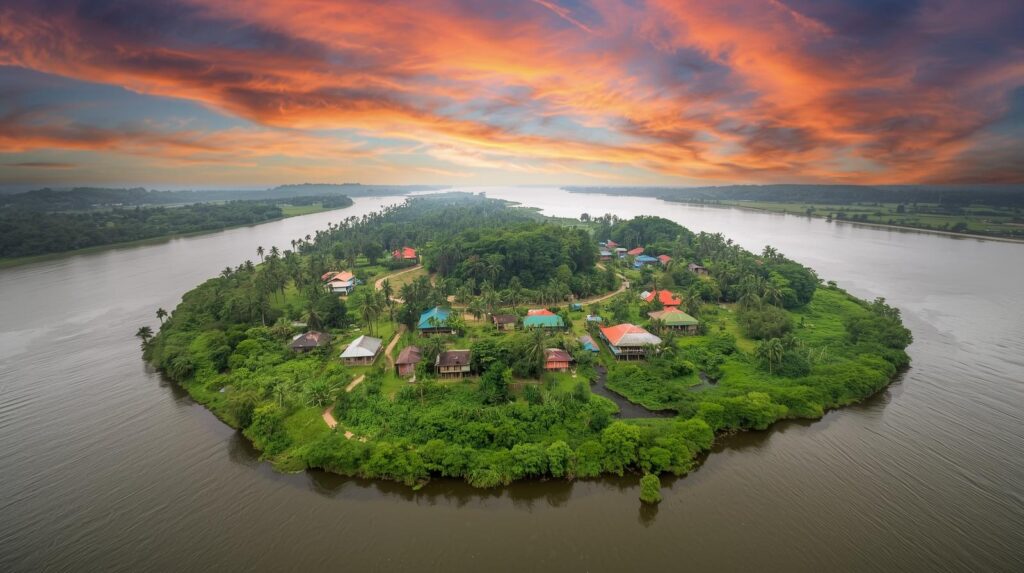
Going to Majuli Island is an Adventure in Itself
Getting to Majuli gives off the vibe of an Indiana Jones adventure—half organizational conundrum, half poetic dream across the largest river in Asia. Up to 10 kilometres in width at the height of the monsoon season, the Brahmaputra (which translates to son of Brahma in Sanskrit) makes bridges useless. Ferries are the new holy chariots, making crossing the river a breeze. 20 kilometres upstream to the north east part of India is Jorhat, the capital of Assam’s tea industry. Jorhat is the main entry point to the region with the Jorhat Airport, connected to Guwahati and Kolkata, and the Jorhat Town Rail Station, which is part of the Northeast Frontier line from Delhi or Bengaluru.
From Jorhat Airport, a 30-minute cab ride (about ₹ 500-800) takes you to Nimati Ghats, the busy ferry terminal. Here, government-run ferries (double deckers, each with a capacity of 100 passengers) make the round trip to the terminal in 30-45 minutes. They leave every hour, on the hour, from 7 AM to 4 PM. Each trip costs ₹ 20-50, with cars priced about ₹ 500 plus. The pre-monsoon season is the ideal period for making the trip: you can watch and listen to the singing dolphins (gangetic type) and golden langurs on the sal trees. The scenery is spectacular. For one in the mood for some excitement, the speedboats make the trip in di0 minutes, though one sorely misses the scenery. The trip costs ₹ 300-500.
Trains from Guwahati take 6 hours, post which the passengers take a 50-100 ₹ auto-rickshaw or bus to the Ghat after alighting at Jorhat. On the Saraighat Express, one can watch glimpses of the Brahmaputra River. From Kaziranga National Park (which is 2 hours to the south) or capital Dispur, one can use National Highway 37 to get to Jorhat, though the stretches post-monsoon have a lot of potholes which can be nasty to drive through. Eco-minded folks can take a bike ride from Jorhat to Majuli for about 4 hours which’ll take you through some really nice tea estates. Try rural ferries to break the ride.
It is easy to find cycle-rickshaws or vans that will take you 15 kilometers inland for 100 – 200 INR once ashore at Kamalabari or Luit Ghat. 15 kilometers is more than enough to get a proper feel for Majuli. From the light noises the river makes to the colors the paddies paint, you know you are entering Majuli’s embrace. Once you get to Majuli Island, per the guides you should know that these are also not hurried ways to get there. During the dry season Majuli also drys helps the river take a nap. During this time, the patches of the island are easier for the island to function having patches of lotus. During this time, Majuli will take you around at a comfortable 20-28°C with a crisp, 10-15°C at night. This will give you time to converse around stories by the Mishing people around a water body with bonfire or to take leisurely strolls along the path of the monastries. The season of winter is also a spectacle in itself. It sharpens the atmosphere to enhance the beauty of the nearby Kaziranga hills. The songs of the wetland, which were pretty ordinary, will be altered to a classical peice.
The highlight of November is Raas Leela, a cultural supernova drawing 50,000 devotees to Satras for Krishna’s nocturnal ballet. ‘Raas Leela’ basically means ‘to dance’ and ‘to enjoy,’ and christens the Devi Raas. This festival is perhaps the most enchanting of the Most Assamese festivals. Where Majuli is lovable to the heart, December-January is lovable to the soul with the Majuli Bird Festival, where ornithologists and artists converge amid 150+ species, from glossy ibises to whistling ducks, est. 150 species of songbirds. February’s Ali Ai Ligang pulses with Mishing vitality: fields ablaze with yellow mustard, villages echoing with ali (flute) melodies, and communal feasts of roasted duck.
Spring (March-April) blooms with Bohag Bihu, Assam’s New Year, where young men in dhoti-kurta woo maidens with husori songs door-to-door, and the island’s bio-diversity peaks—orchids carpeting bamboo groves, butterflies flitting like confetti. Avoid the sweltering May-October monsoon, when deluges swell the river, submerging 30% of Majuli and stranding ferries. Humidity soars to 90%, leeches lurk in trails, and Satras shutter for flood vigils. Yet, for the hardy, post-monsoon September whispers renewal: receding waters reveal nutrient-rich silt, birthing verdant carpets that foreshadow the harvest.
When is the best time to visit Majuli? For culturally-inclined, November is the best time. For the nature-inclined, winter is perfect. For the people who love festivities, spring time is best. Our travel guide to Majuli goes by the saying, “It is best to visit when the season lifts your spirit, as Majuli is best enjoyed when the heart is aligned.”
Discover the best things to do in Majuli: Enjoyable activities in the “Holi Island” of India.
Majuli is a place of many experiences. This is best demonstrated by the Satras which you should visit as part of your trip. The oldest, Dakhinpat Satra, with a history that dates back to 1584, is a must visit for the pottery workshops; Watch craftspeople sculpt wheel-thrown terracotta to make lamps and other ritual items. And you can surround yourself with a 15 hectare site including the library with 300 year old astrology and ethics manuscripts. Explore the courtyards of Auniati Satra where the bhakats in white dhotus sing and rehearse their devotion to Sankardeva while you enjoy the Borgeet hymns.
Join your fellow students in the Garamur Satra workshops to learn the Sattriya dance. Master the tribhanga pose with your torso and head while your gurus tell the story of Radha. These places aren’t tourist traps; they’re a true Majuli Island experience where you form a true connection with the monks over a cup of tea spiced with wild lemongrass.
In a few hours, we can engage lots of people in the Mishing heart’s rhythm: Eat apong, listen to river spirit tales, and toast your homestay friends as you perched on a chang ghar perched 10 feet high. Encounter artisans: women sewing Ahimsa eri silk into gamocha towels and men canoeing driftwood. This is the real Majuli im tourism: Handwoven baskets, rice planting, and bartering mud. We grow acquainted with the mud as it grows acquainted with you.
Majuli is a birdwatchers’ delight. 130 square kilometers of the wetlands are under the Ramsar classification do library quatsh. There are 200+ birds to ilir country is to listen to the calls of the Siberian cranes. 10,000 kilometers and we meet in the rice. The bugling calls announce a migratory alarm.
Majuli is festivals and rhythm: raas, Ali Ai Ligang, gumrag, and moonlit Cherpu Purnima. The crone heroine’s tunes are woven into the pottery. The 10 km Joymoti Trail thread the betel nut groves and lotus ponds, capturing dew-kissed spiderwebs, and lone fishers as they cast nets at dusk. The grind of microphones cam movement obsessive collectors and archetype gatherers while the children and camera spiderwebs and fishers at dusk. They aid each other. They walk the bridges of spaces and take river roads. These pursuits are not a checklist: they are a symphony of each sense.
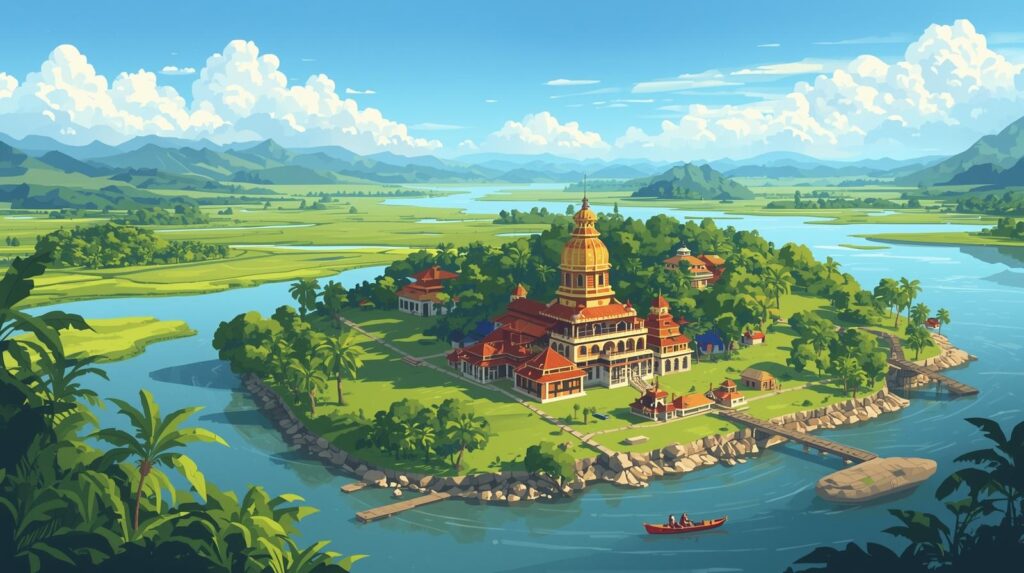
Where to Stay in Majuli: Havens of Hospitality and Harmony
In Majuli, sleep is more than just a place to spend the night. It is an experience where one gets to embrace the culture of the place. Majuli really is the best for homestays. ‘Adi Parashmoni’ is a great one to start with. It is near Auniati Satra, run by a Mishing family. It is also built stil on stilts, with thatched roofs for the rest of the family. Rooms here are also quite reasonable, costing around 1000-2000 INR a night, which also includes meals. You can experience family style meals, family recipes served to you on a banana leaf, and even join in the morning pujas, the entire family sings for praises. You can also enjoy the sunrise with the family; they also have a cock and are built in the middle of the family. The ‘La Maison de Himchari’ is also quite relaxing and near Kamalabari. It has an Assamesse style with a solar powered minimalism and relaxing yoga sessions on the river.
If you are in the Satra and Garamur area, the Satra guesthouses have monastic vibes and great for budget people. They have simple spartan cells which is great to give you rest for the night and the room is only 500-1000. The Satra area and Garamur also offer community tents for budget people during festival time. Jorhat’s alternatives, also like Hotel Pinewood, suit luxury (3,000+) but miss the immersion. Prioritize eco-stays, for mangrove replanting. It is also built stil on stilts, with thatched roofs for the rest of the family. Rooms here are also quite reasonable, costing around 1000-2000 INR a night, which also includes meals. You can experience family style meals, family recipes served to you on a banana leaf, and even join in the morning pujas, the entire family sings for praises. You can also enjoy the sunrise with the family; they also have a cock and are built in the middle of the family. The ‘La Maison de Himchari’ is also quite relaxing and near Kamala Bari. It has an Assamesse style with a solar powered minimalism and relaxing yoga sessions on the river.
Local Food and Cuisine: Flavors of the Floodplains
Majuli’s larder is the Brahmaputra’s bounty—organic, unadorned, and soul-stirring. Khar, a caustic-free alkaline dish from banana stem ash, tenderizes duck or fish into melt-in-mouth succulence, balanced by creamy mustard paste. Tenga, the sour symphony, marries black-sour lentils with rosy barb fish, its tang from elephant-apple slices evoking river freshness. Rice reigns: jolpan breakfasts of puffed beaten rice with curd and jaggery, or thekua sweets—diamond-cut semolina fried golden, festival fare.
Pithas steal the show: seasonal rice cakes stuffed with coconut-sesame, steamed in bamboo molds. Homestays conjure these with foraged greens like poi (fern) or kolmou (water spinach), paired with jolki (fermented bamboo shoots) curries. For vegetarians, masor tenga swaps fish for lentils; omnivores, pitika mashed veggies with mustard oil. This Majuli Assam cuisine isn’t gourmet—it’s genesis, as in Assam travel blog lore, where every bite narrates flood-forged resilience.
Travel Tips for Majuli: Wisdom from the Waters
If you want to experience a quiet Majuli, take the morning ferry. Bring cash, around 5,000 INR, because there are no ATMs. Bring light cotton clothes and some rain gear since Majuli can get rainy and warm. After the floods, there are leeches as well, so some insect repellent is a good idea. Instead of disposable plastics, bring jute bags and you can learn the phrase “nemone xobi” to say thank you. In the Satras, you must also observe modesty, so cover your shoulders and take off your shoes. You can hire a local guide for Mishing insights for 500 INR a day. You must also drink filtered water and relax; Majuli will reward you for your patience. While in Assam for sustainable tourism, tread gently and leave feeling empowered.
You may also like our detailed guide on Chopta Tungnath Trek – Complete Travel Itinerary
Conclusion: Eternal Echoes of Majuli
Majuli is a dialogue. It is a conversation with the divine, where rituals and the river intertwine. From the Satras, and the songs to the quiet mornings with the birds, Majuli cradles the spirit and echoes, holding you within. It is a dialogue. Let yourself echo Assam, and let Majuli voice your journey. Venture forth to the world’s largest river island. Your journey awaits.